Motion-Activated Security Light Installation in Austin: Protecting Driveways, Side Entrances, and Backyard Access Points
Outdoor security lighting is one of the simplest ways to improve visibility around a home while making exterior spaces more comfortable and secure after dark. Whether homeowners are concerned about someone approaching a side entrance, walking through an unlit driveway, or accessing a backyard through a fence gate, properly positioned motion-activated lighting can make a noticeable difference. Instead of leaving every exterior light on throughout the night, motion-activated fixtures illuminate specific areas when movement is detected.
For Austin, Texas homeowners, this can be especially useful around garages, front porches, detached workshops, side yards, and backyard entrances. From motion-activated floodlights around garages and driveways to smart security lighting with integrated cameras, Austin homeowners can rely on Tejas Electric for professional security light installation designed to improve nighttime visibility and help protect their properties. The right installation considers more than simply mounting a bright fixture on an exterior wall. Sensor placement, lighting coverage, electrical connections, and the surrounding environment all influence how well a security lighting system performs.
Let’s look at several ways Austin homeowners can use motion-activated security lights to address common outdoor lighting concerns.
1. Installing Motion-Activated Floodlights Around Front Entrances and Driveways
Front entrances and driveways are natural starting points when planning an exterior security lighting upgrade. These areas experience regular foot traffic, package deliveries, visitors, and vehicle movement. However, a poorly illuminated driveway can leave homeowners struggling to see who is approaching the property after sunset.
Motion-activated LED floodlights can provide a practical solution. When someone walks toward the front entrance or enters the driveway, the fixture detects movement and illuminates the surrounding area. This makes it easier to identify visitors, locate keys, navigate steps, and see potential obstacles.
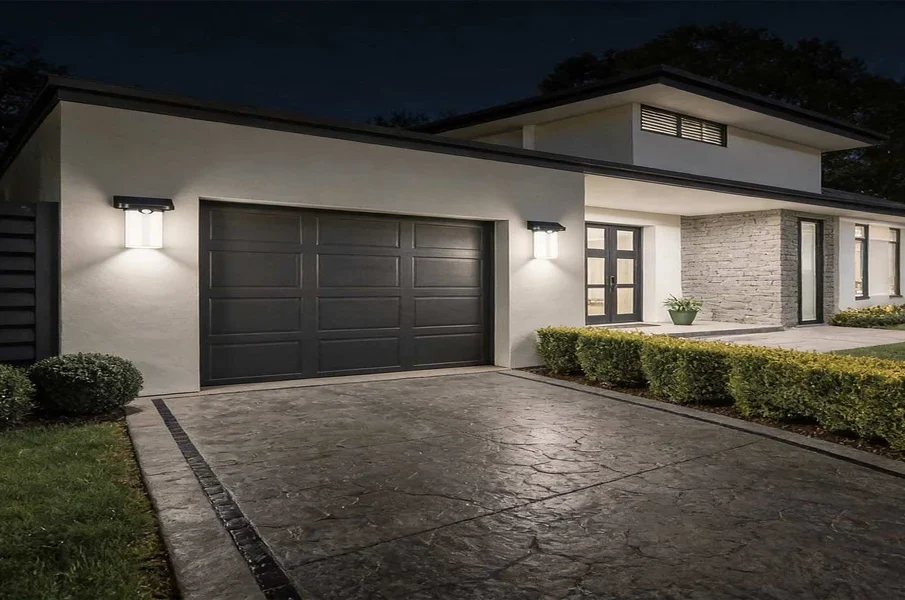
For homes with attached garages, mounting floodlights above or beside the garage door can provide broad illumination across the driveway. However, the fixture should be positioned so its sensor detects people approaching the property rather than constantly reacting to vehicles passing along the street.
Front porch lighting presents a slightly different challenge. Homeowners may prefer a fixture that provides enough illumination to identify visitors without producing an uncomfortable amount of glare. A smaller motion-activated wall fixture can work well near the front door, particularly when paired with existing porch lighting.
The goal is to create overlapping coverage where necessary without making the property excessively bright.
2. Adding Motion-Activated Lighting Around Back Doors and Backyard Access Points
Back doors are sometimes overlooked when homeowners plan exterior security improvements. While the front entrance may already have a porch light, the rear of the property might have limited illumination, especially if the backyard extends beyond the home’s existing outdoor lighting.
A motion-activated fixture near a back door can help illuminate the immediate entrance when someone approaches. This is particularly useful for homeowners who regularly let pets outside, use their backyard in the evening, or access outdoor storage areas after dark.
Other locations worth considering include:
- Back doors leading to patios and covered outdoor living spaces.
- Gates connecting the backyard to an alley or neighboring access area.
- Detached garages and storage buildings.
- Outdoor kitchens and covered entertainment areas.
- Walkways connecting the home to a workshop or garden.
- Fence openings and side-yard pathways.
Austin properties can have very different backyard layouts. A newer home in Mueller may have a compact outdoor space with limited side access, while a larger property in Circle C Ranch or Steiner Ranch may have multiple pathways, gates, and detached structures.
These differences matter when choosing fixture locations. One strategically positioned floodlight may be sufficient for a small patio, while a larger property may benefit from several independently controlled motion-activated fixtures.
3. Traditional LED Motion Lights vs. Smart Motion-Activated Security Lighting
One of the first decisions homeowners face is whether to install traditional LED motion lights or invest in smart security lighting.
Both options can improve outdoor visibility, but they offer different features.
Traditional LED motion-activated fixtures
Traditional motion lights use built-in sensors to detect movement and activate the fixture. Many models allow homeowners to adjust sensitivity, illumination duration, and ambient-light settings.
Their biggest advantage is simplicity. Once properly installed and configured, they generally operate automatically without requiring a smartphone, wireless connection, or additional smart-home equipment.
These fixtures are often a good choice for:
- Driveways and garage entrances.
- Side yards and fence gates.
- Back doors and utility entrances.
- Detached garages and workshops.
- Areas where dependable automatic illumination is the main priority.
Smart motion-activated security lights
Smart fixtures offer additional control through compatible smartphone applications and connected home systems. Depending on the product, homeowners may be able to receive motion notifications, adjust lighting schedules, customize detection zones, and control brightness remotely.
Some systems also incorporate cameras, microphones, and two-way audio.
These features can be useful when homeowners want more than basic illumination. For example, a smart security light with an integrated camera above a garage may provide both nighttime visibility and video monitoring of the driveway.
However, smart lighting introduces additional considerations. Homeowners should evaluate Wi-Fi coverage, product compatibility, application requirements, privacy settings, and whether the fixture needs a dedicated power connection.
Tejas Electric can help homeowners evaluate their electrical requirements and determine appropriate mounting locations when planning a traditional or smart security lighting upgrade.
4. Positioning Motion Sensors to Avoid False Activations
One of the most common complaints about motion-activated outdoor lighting is that the fixtures turn on when nobody is approaching the home.
A light might activate every time a vehicle drives down the street, a neighbor walks past the property, or tree branches move in the wind. While the fixture technically works, frequent false activations can become frustrating.
Proper sensor placement can help prevent this problem.
Motion sensors should generally be directed toward the areas where homeowners actually want movement detected. For example, a garage floodlight should monitor the driveway and garage approach rather than point directly toward the street.
Several factors influence sensor performance:
Detection direction: Sensors should face the intended approach area instead of monitoring unnecessary portions of the surrounding property.
Mounting height: The manufacturer’s recommended installation height affects the detection pattern and coverage area.
Sensitivity settings: Adjustable sensitivity can help reduce activation from distant or incidental movement.
Environmental interference: Trees, shrubs, reflective surfaces, and nearby heat sources may affect how certain sensors operate.
Traffic patterns: Homes located near busy residential streets may require more careful sensor positioning than properties with long private driveways.
Many motion lights use passive infrared (PIR) technology, which detects changes in infrared energy. Because these sensors respond to changes in heat patterns, their placement and viewing angle can influence performance.
A professional installation can help homeowners avoid common positioning mistakes before the fixtures are permanently mounted.
5. Choosing the Right Brightness and Beam Angle for Each Area
A brighter security light is not automatically a better security light. The most effective installation provides enough illumination for the intended area without creating unnecessary glare or disturbing nearby properties.
Lumens measure the amount of visible light produced by a fixture. When comparing outdoor lighting products, homeowners should consider the size of the area being illuminated, mounting height, beam spread, and surrounding obstacles.
Different locations may require different lighting characteristics.
| Installation location | Lighting considerations |
| Front entrance | Moderate, comfortable illumination with controlled glare |
| Garage and driveway | Wider beam coverage to illuminate vehicles and approaching visitors |
| Side yard | Focused illumination along narrow pathways |
| Backyard gate | Targeted lighting around the gate and access path |
| Detached garage | Broader coverage depending on building size |
| Patio or outdoor living area | Balanced lighting that provides visibility without excessive brightness |
Beam angle is equally important. A narrow beam concentrates light in a smaller area, while a wider beam spreads illumination across a larger space.
For example, a floodlight above a two-car garage may need a wider beam to cover both vehicle parking spaces. A smaller fixture near a side entrance may provide better results with a more focused beam.
Austin homeowners should also consider how outdoor lighting affects neighbors. Directing fixtures downward and selecting appropriate beam patterns can reduce light trespass while maintaining useful coverage.
6. Installing Security Lights High Enough to Discourage Tampering
Mounting height is another important part of security light installation.
Fixtures installed too low may be easier to reach, damage, or accidentally bump. However, mounting a fixture excessively high can reduce its effectiveness or make maintenance difficult.
The ideal mounting location depends on the manufacturer’s specifications, the fixture’s detection range, the property’s architecture, and the area being illuminated.
Garage-mounted floodlights are often positioned near the upper portion of the exterior wall. This provides a useful vantage point for illuminating the driveway while keeping the fixture relatively inaccessible.
For side entrances, the mounting location should account for rooflines, overhangs, nearby fencing, and potential obstructions.
Homeowners should also consider how the fixture will be accessed for future maintenance. Bulbs, sensors, camera lenses, and electrical connections may eventually require inspection or replacement.
A licensed electrician can evaluate the mounting surface and electrical requirements to help ensure the fixture is installed securely and positioned for effective operation.
7. Adding Motion Sensors to Previously Unlit Garages, Fences, and Side Yards
Some of the most useful security lighting improvements involve areas homeowners rarely think about until they need to walk through them at night.
Side yards are a good example. These narrow spaces often contain air-conditioning equipment, electrical service equipment, water connections, trash containers, or pathways leading to backyard gates. Without adequate lighting, navigating these areas can be inconvenient.
Adding motion-activated lighting can make these spaces easier to access while improving nighttime visibility.
Detached garages and workshops are another opportunity. Properties throughout the Austin area may have separate structures that are not adequately covered by the home’s existing exterior lighting.
A dedicated motion light can illuminate the entrance whenever someone approaches the building.
Fence lines and gates may also benefit from additional lighting, particularly when a gate provides access to an alley, side street, or backyard storage area.
Before installing fixtures in these locations, homeowners should consider whether an existing outdoor electrical connection can support the new lighting or whether additional wiring will be necessary.
8. Evaluating Existing Outdoor Wiring Before Installing New Fixtures
Not every home has the electrical infrastructure needed for additional exterior lighting.
Some properties already have outdoor electrical boxes, switched lighting connections, or appropriately located wiring that can accommodate a new fixture. Other homes may require new electrical connections or modifications to existing circuits.
Before installation begins, the electrical system should be evaluated.
Important considerations include:
- Whether an existing circuit has sufficient capacity.
- Whether the proposed fixture location has an appropriate electrical connection.
- Whether existing outdoor wiring is damaged or deteriorating.
- Whether the installation requires new wiring through an exterior wall or attic.
- Whether the electrical box and mounting surface are suitable for the fixture.
- Whether appropriate grounding and weather protection are provided.
Homeowners should avoid assuming that an existing outdoor light connection can automatically support every new security lighting product.
Smart security fixtures, particularly those incorporating cameras and additional electronics, may have specific voltage and installation requirements.
If new wiring is necessary, the electrician must determine the appropriate routing and installation method. Exterior penetrations also need suitable sealing to help prevent moisture from entering the home’s walls.
These details are especially important in Central Texas, where outdoor electrical equipment can experience intense summer heat, heavy rain, humidity, and occasional severe storms.
9. Using Weather-Resistant Fixtures and Outdoor Electrical Connections
Outdoor security lights are exposed to considerably harsher conditions than most indoor fixtures.
Sun exposure, wind-driven rain, dust, insects, and temperature changes can gradually affect outdoor electrical equipment. Selecting fixtures designed for exterior use helps reduce the likelihood of premature deterioration.
Homeowners should look for fixtures with an appropriate Ingress Protection (IP) rating or other manufacturer-specified outdoor suitability. The fixture should be rated for its intended location and exposure.
Other important installation details include:
Weather-resistant electrical boxes: Exterior boxes should be appropriate for the installation and compatible with the selected fixture.
Suitable covers and fittings: Connections need appropriate weather protection based on whether they are exposed to rain or installed in more sheltered locations.
Proper sealing: Exterior wall penetrations should be sealed with suitable materials to help prevent water intrusion.
Corrosion-resistant hardware: Outdoor mounting hardware should be appropriate for the environment.
Proper grounding: Metal fixtures and electrical components must be installed with appropriate grounding and bonding provisions.
A fixture advertised for outdoor use does not eliminate the need for correct installation. Even a high-quality security light can develop electrical problems if its connections are improperly protected.
10. Is Motion-Activated Security Light Installation a DIY Project?
For homeowners who enjoy tackling weekend improvement projects, installing outdoor lighting may seem relatively straightforward. Some battery-powered or solar-powered motion lights can be installed without making changes to the home’s electrical system.
However, permanently installing hardwired security lighting is a different matter.
A handy homeowner may be comfortable assembling a fixture, mounting a solar light, or replacing certain components within their experience and applicable safety requirements. But running new electrical wiring, modifying existing circuits, installing outdoor junction boxes, or connecting hardwired floodlights introduces electrical hazards.
Potential problems include:
- Electrical shock or electrocution.
- Improper grounding.
- Overloaded circuits.
- Loose or incorrectly terminated connections.
- Water entering electrical boxes.
- Damaged wiring concealed behind exterior walls.
- Incorrect fixture mounting or inadequate support.
Texas electrical licensing requirements also matter. Homeowners should not assume that being handy automatically qualifies them to perform electrical work on another person’s property or that every type of electrical installation is exempt from licensing requirements.
For hardwired security lighting, hiring a properly licensed Texas electrician is the safer and more dependable approach. A qualified electrician can evaluate circuit capacity, identify appropriate wiring routes, select suitable electrical boxes, and ensure the installation meets applicable electrical code requirements.
This is particularly important when adding multiple fixtures or installing smart security lights that require new electrical connections.
If you are considering a more extensive exterior lighting upgrade, Tejas Electric can help assess the electrical work involved and determine an appropriate installation plan.
11. Why Austin Homeowners Should Have a Licensed Electrician Evaluate the Installation
Security lighting is most effective when the entire installation is planned around the property rather than treating every fixture as an isolated project.
A licensed electrician can look at the home’s existing electrical system and identify potential issues before new fixtures are installed.
This includes evaluating circuit capacity, checking existing outdoor wiring, determining whether additional connections are necessary, and identifying mounting locations that provide useful coverage.
A professional evaluation is also valuable when combining multiple lighting technologies.
For example, an Austin homeowner might want traditional LED floodlights over the garage, smart motion-activated lighting near the backyard entrance, and a smaller fixture along a side walkway. Coordinating these installations can provide more consistent coverage and reduce unnecessary electrical modifications.
Tejas Electric provides residential electrical services for homeowners throughout Austin and surrounding Central Texas communities. Whether you are upgrading an older exterior fixture or planning a more comprehensive security lighting project, working with an experienced electrical contractor can help ensure the installation addresses your property’s actual needs.
Improve Your Property’s Outdoor Visibility With Professionally Installed Security Lighting
Motion-activated security lights offer homeowners a convenient way to illuminate important areas of their properties without leaving outdoor fixtures running continuously. From garage entrances and front porches to backyard gates and previously unlit side yards, the right combination of fixtures and sensors can make nighttime navigation easier while adding another layer of awareness around the home.
The key is selecting appropriate lighting, positioning sensors correctly, providing adequate coverage, and making sure all electrical connections are suitable for outdoor conditions.
Whether you prefer traditional LED floodlights or want the additional features of smart security lighting with integrated cameras, planning the installation carefully can help you get better results.
When new wiring, electrical connections, or hardwired fixtures are involved, professional installation is worth considering. A qualified Texas electrician can evaluate the existing electrical system and help ensure the work is completed safely and correctly.
For homeowners looking to improve exterior lighting around their Austin properties, Tejas Electric offers professional electrical services designed around the needs of local homes. Contact Tejas Electric to discuss your security light installation project and explore practical ways to improve visibility around your driveway, entrances, garage, and backyard access points.
About Author