Tracing Hill Country Hard Water Through Every Pipe in Your Home
Water in the Austin area has done plenty of traveling before it ever reaches your kitchen sink. Most of it starts in Lake Travis and Lake Austin, fed by the Colorado River, and along the way it moves over and through the limestone that shapes so much of Central Texas. Limestone dissolves slowly, so the water picks up calcium and magnesium as it goes. By the time it arrives at your house, it is carrying a load of dissolved rock that nobody can see.
That load stays invisible until something makes it come back out. Heat does it. Evaporation does it. A slow drip does it over months. The result is scale, the chalky white or tan crust you find on a showerhead or at the bottom of a kettle. Austin’s utility also treats its supply with chloramine, a disinfectant that lasts longer in the pipes than plain chlorine but can be tough on some rubber parts over time. Together, minerals and treatment chemistry shape how nearly every piece of plumbing in a local home ages.
Homeowners who want someone local to look at the full picture often turn to Garrett’s Plumbing, a family owned outfit whose roots in the trade go back four generations and whose own hands-on experience spans 27 years. Their crew installs and repairs water softeners and water heaters, tracks down hidden leaks, clears drains, repairs sewer lines and works across copper, PVC and PEX, which covers most of the stops on the route described below.
Where the Water First Walks In
The journey begins at the main line, usually entering near the front of the house or through the slab. This is the smartest place to deal with hardness, because anything treated here protects everything downstream. A water softener does that job through ion exchange, trading the calcium and magnesium for sodium or potassium as water passes through a bed of resin beads.
A few details decide whether a softener actually helps or just sits in the garage.
- Sizing. A system that is too small regenerates constantly and wastes salt and water. Too large and the resin can sit unused long enough to channel. Sizing depends on your household’s daily use and your measured hardness, so a real water test beats a guess.
- Salt bridges. A hard crust can form inside the brine tank, leaving an empty pocket underneath. The tank looks full while the system is actually running dry. Pushing a broom handle down through the salt now and then reveals it.
- Bypass lines. Many installers leave outdoor spigots unsoftened, since there is no reason to send treated water onto the lawn. Some families also keep one unsoftened tap in the kitchen for drinking.
- Chloramine. A standard softener does not remove it. If taste or rubber wear is a concern, a carbon filter paired with the softener handles that part.
Heat Is Where the Rock Comes Back
Follow the water to the heater and you reach the spot that suffers first. Warming water pushes dissolved minerals out of solution, and they settle as sediment on the bottom of a tank or build up on the heating elements of an electric unit.
The signs tend to show up in this order. You hear popping or rumbling when the burner fires, because water trapped under the sediment boils in bursts. Then hot water runs out sooner than it used to. Eventually the tank leaks at the base. Draining and flushing a tank once a year slows all of this down, and checking the anode rod every few years keeps the tank lining from corroding from the inside.
Tankless heaters are not immune. Their narrow heat exchangers scale up quickly in hard water, and most manufacturers call for a regular descaling flush. Skipping it can shorten the unit’s life and, in some cases, create warranty trouble.
Small Parts With Stubborn Crust
From the heater, water splits off to every fixture in the house, and each one collects its share of mineral.
- Faucet aerators clog with grit and flakes of scale, turning a steady stream into a sputtering spray.
- Showerheads lose nozzles one by one until the pattern goes lopsided.
- Toilet flappers and fill valves wear out sooner, and a flapper that no longer seals lets the tank run and refill all night.
- Shower valve cartridges stiffen and start to stick or drip.
That last one worries people most, because the valve sits behind tile. The good news is that many cartridges can be replaced from the trim side, and a skilled plumber can often reach a failed valve without tearing up the wall. Asking about that option before anyone picks up a hammer can save a full retiling job.
Inside the Walls, Where Nobody Looks
Between the fixtures run the supply pipes. Older homes may still have copper, which holds up well but can develop pinhole leaks, especially where water chemistry and flow speed work against it. Newer builds and many repipes use PEX, which resists scale buildup and flexes rather than splitting. CPVC shows up in some homes built in between.
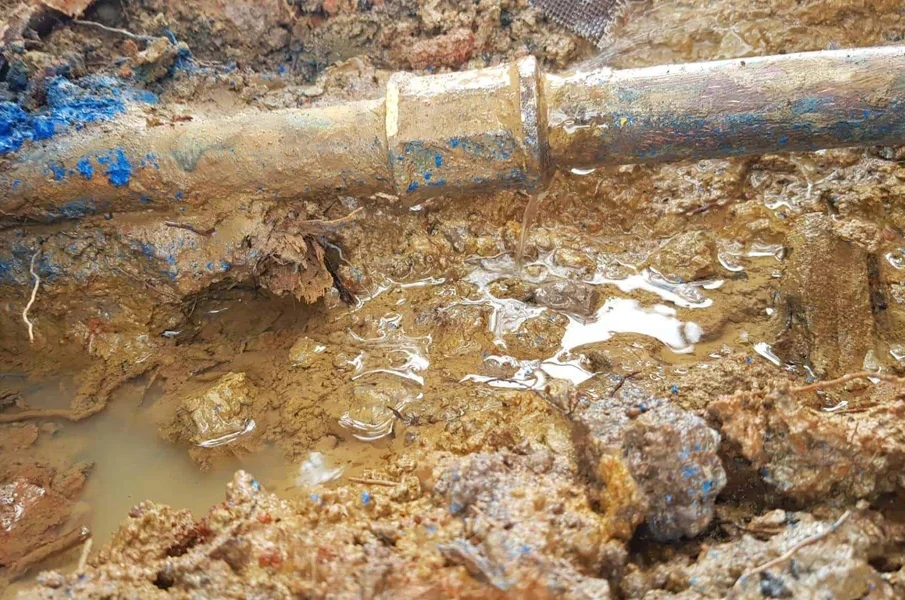
Leaks hidden in walls or under a slab rarely announce themselves early. A simple meter check helps you catch one.
- Turn off every faucet, appliance and irrigation zone in the house.
- Find the water meter and look at the leak indicator, usually a small triangle or dial.
- If it keeps moving with everything off, water is escaping somewhere.
Warm spots on a floor, a musty smell in one closet, or a bill that climbs without explanation are other clues worth calling in professional leak detection for.
The Way Out Matters Too
Once water has done its job, it heads for the drains, and hard water still has a role to play. Minerals react with soap to form a sticky scum that coats pipe walls, catches hair and grease, and slowly narrows the passage. Shower and bathtub drains are usually the first to slow.
Past the house, the sewer line faces its own local pressures. Much of eastern Austin sits on clay that swells in wet months and shrinks in drought, which can shift older lines and open joints. Big live oaks send roots toward those openings in search of moisture. A camera inspection shows exactly what is happening underground, which matters far more than guessing from a single backup.
A Simple Rhythm for the Year
Hard water is not going anywhere, but its damage is mostly slow and predictable. Flushing the water heater each year, soaking aerators and showerheads in vinegar every few months, keeping an eye on the softener’s salt, and running a meter check whenever a bill looks off will keep most homes ahead of the problem. When something does fail, knowing which part of the journey it belongs to makes the fix faster and the conversation with your plumber a lot more useful.
About Author